Asthma telemedicine works well as an add-on for routine follow-up, helping with monitoring, adherence and action-plan reviews, especially when video visits are paired with remote devices such as smart inhalers and peak-flow meters. It typically combines video consultations, remote patient monitoring, health apps and e-consults. Severe exacerbations and first-time diagnostic testing such as spirometry still call for in-person care.
TL;DR:
- Combined telehealth case management improved asthma control with a standardized mean difference of 0.78; combined programs also improved quality of life more than video alone.
- A review of 16 pediatric trials involving 2,642 children found a mean difference of 0.61 in asthma control scores, with limited quality of life gains.
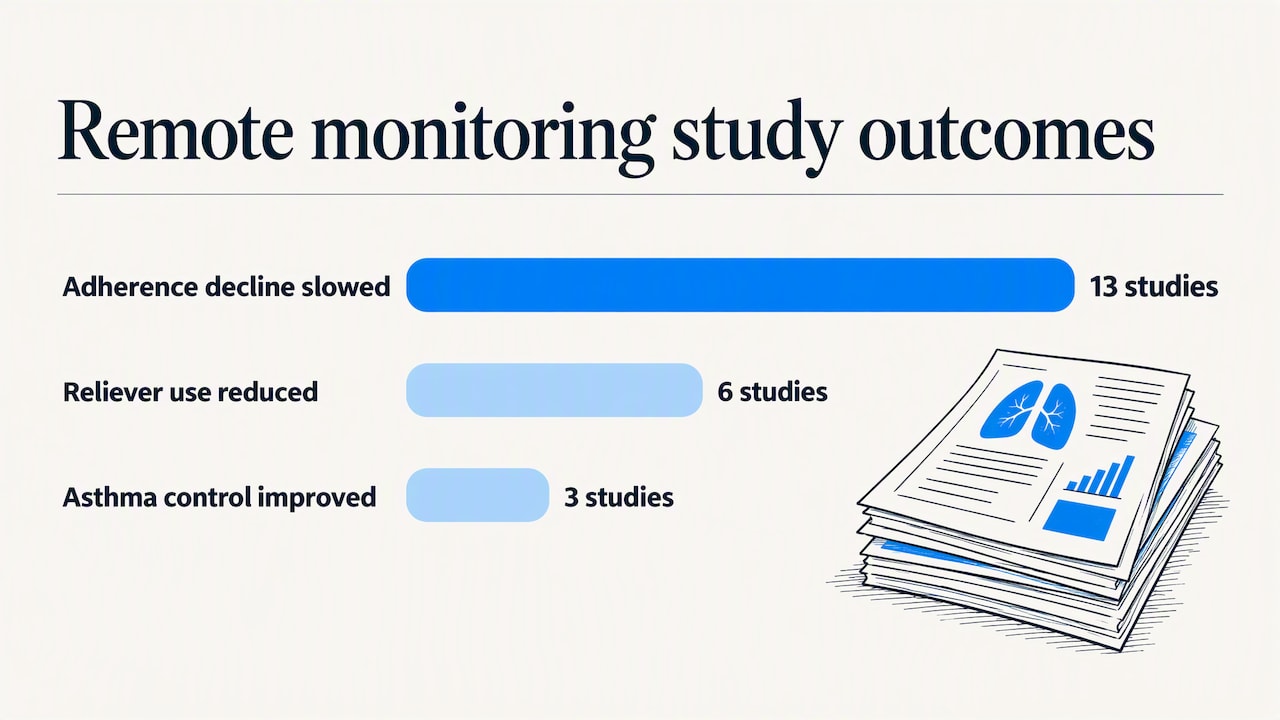
- Of 19 remote monitoring studies, 13 found slower adherence decline and six found lower reliever use; effects on exacerbations and health care use remained inconsistent.
- Ask your clinician to review device records before visits, watch your inhaler technique on video, and write clear alert thresholds into your action plan.
- An uncertain diagnosis, persistently low readings, or a need for spirometry warrants in person assessment; severe breathing trouble requires emergency care, not a video appointment.
Table of Contents
- What asthma telemedicine includes: models and tools
- What the research shows about outcomes for adults and children
- Remote monitoring technologies and how clinicians use the data
- Clinical best practices for asthma teleconsultations
- How to prepare for an asthma telemedicine visit
- Who benefits most, and the main barriers
- Protocols for managing asthma exacerbations via telemedicine
- Insurance coverage and reimbursement for asthma teleconsultations
- Patient education resources and digital self-management tools
- Legal and regulatory considerations for tele-asthma care
- Integrating telemedicine with in-person services and specialist referrals
- My view: telemedicine belongs in routine, hybrid asthma care
- How we can support your asthma follow-up
- FAQ
- Sources
What asthma telemedicine includes: models and tools
Telemedicine is not one thing. Clinical reviews describe several models, and the choice of model should follow the care goal: synchronous visits for demonstration and review, asynchronous monitoring for continuous surveillance. Knowing the differences helps you ask for the right setup.
Here are the main models and what each does best:
- Direct-to-consumer video visits: you see a clinician by video from home. This suits routine reviews, medication changes and watching you use your inhaler.
- Facilitated virtual visits: a trained helper, a “telepresenter” such as a school nurse, sits with the patient and operates the equipment while the clinician joins by video. This is common in school-based programs.
- Remote patient monitoring (RPM): devices such as smart inhalers, peak-flow meters and pulse oximeters send readings to a clinician dashboard between visits.
- Mobile health apps: symptom diaries, reminders, medication logs and action-plan tools that you carry on your phone.
- E-consults: a primary care clinician sends a case, with data, to a specialist for written advice, without a full appointment.
Each model covers different tasks. Checking inhaler technique works well on video, because the clinician can watch you press, inhale and hold your breath, then correct mistakes on the spot. Objective adherence tracking belongs to smart inhalers, which record when a dose was taken instead of relying on memory. Triage and second opinions fit e-consults, where a specialist reviews records and suggests a plan without the patient traveling.
The data that travel between you and your care team usually fall into these groups:
- Inhaler event logs showing the date and time of each dose, and in some devices how well you inhaled
- Peak-flow values, usually a morning and evening reading
- Oxygen saturation (SpO2) from a fingertip oximeter
- Symptom diaries or questionnaire scores, such as the Asthma Control Test
Clinicians typically review these before the visit, often on a dashboard that flags patterns: a rising count of reliever puffs, a drop in peak flow, or missed preventer doses. Best-practice guidance for asthma telemedicine programs says to review device data before the visit, reinforce inhaler technique on video, and send written instructions through a patient portal. That sequence turns a short call into a focused conversation about what the numbers actually show.
A practical way to think about it: the video visit is where decisions are made, and the remote data are what make those decisions specific to you. Without data, a teleconsultation relies on how you remember your recent symptoms and treatment. With data, the clinician can see whether your reliever use has climbed, which may point to a trigger or a missed preventer dose.
Models can be combined. A family might use an app for daily symptoms, a smart inhaler for the preventer, and a video visit every few months. A school program might use a telepresenter for children who cannot easily reach a clinic. The right mix depends on how stable the asthma is, how comfortable you are with technology, and what your clinician can review. If you are unsure where to start, ask your clinician which single tool would change their advice the most. For many people it is either a simple peak-flow diary or an objective record of preventer use.
What the research shows about outcomes for adults and children
The best evidence comes from systematic reviews, which pool many trials. One systematic review of telemedicine for asthma management concluded that telemedicine positively affects asthma management by improving symptom control, quality of life and treatment adherence. That is encouraging, though the size of the benefit depends on how the program is built.
Combined tele-case management improved asthma control in adults, with a standardized mean difference of 0.78, in a meta-analysis of telemedicine in adults. Programs that combine several elements, rather than a single phone call, tend to produce the clearest gains.
For adults, that meta-analysis also found benefits for quality of life with combined approaches, while stand-alone tele-consultation variants showed smaller but still positive effects. The pattern is worth remembering: a video call alone helps, but a video call plus monitoring, education and follow-up helps more.
Remote monitoring has its own evidence base. A systematic review of remote monitoring in asthma covering 19 interventional studies found that remote monitoring slowed the decline in maintenance inhaler adherence in 13 studies, reduced reliever use in 6, and improved asthma control in 3. The same review did not consistently show fewer exacerbations or less healthcare use, which the authors linked to small samples and short follow-up. In plain terms: the intermediate outcomes move in the right direction, while the “hard” outcomes such as hospital admissions still need larger, longer trials.
Children and adults do not respond identically. A pediatric systematic review of 16 randomized trials with 2,642 participants found that telemedicine improved asthma control scores by a mean difference of 0.61, but had limited effect on quality-of-life measures. Improvements were stronger when interventions included symptom monitoring, education and two-way communication. For parents, the takeaway is that a program with regular check-ins and teaching tends to outperform one that only offers an occasional video call.
Key points to hold on to:
- Telemedicine improves asthma control and adherence in most reviews, and the effect is larger when several components are combined.
- Quality-of-life gains are clearer in adults than in children, where results are modest.
- Effects on exacerbations, emergency visits and admissions are inconsistent, so telemedicine should not be sold as a guaranteed way to avoid hospital care.
- Connected-inhaler systems reliably improve adherence data and intermediate outcomes, but large trials on hospitalizations are still needed.
On cost and system-level impact, the picture is mixed. Studies indicate that telemedicine and digital tools can reduce emergency department visits and hospital admissions in some programs, yet cost-effectiveness analyses remain limited and further health-technology assessment is needed. Honest evidence like this is useful: it tells you that telemedicine is a sound option for routine care while leaving room for the research to mature.
One more point deserves attention. Digital tools give clinicians a more reliable view of adherence. Reviews of digital asthma care note that objective adherence data from digital tools are substantially more accurate than patient self-report and can reveal early warning patterns such as rising inhaler use or falling peak flow. Many people overestimate how often they take a preventer, not out of dishonesty but because daily routines blur together. Seeing the real pattern removes blame from the conversation and focuses it on solutions: a reminder, a different device, a simpler regimen.
Taken together, the evidence supports telemedicine as a dependable way to keep stable asthma on track, and as a way to catch drift in control before it becomes a flare-up. It does not replace the physical examination and testing that diagnosis requires.
Remote monitoring technologies and how clinicians use the data
Remote monitoring is the engine of good asthma telemedicine, so it helps to know what each device records and what a clinician does with it.
Smart inhalers attach to, or are built into, your inhaler. They time-stamp each use and send it by Bluetooth to an app. Some models also sense inhalation flow, which gives a clue about technique. Digital inhalers such as Propeller and Digihaler can track inhaler use and inhalation flow. When the log shows missed preventer doses, a clinician can shift the conversation from “are you taking it?” to “what gets in the way in the evenings?” When reliever puffs rise, it is an early sign that control is slipping.
Peak-flow meters and home spirometers measure how fast you can blow air out. A peak-flow meter is inexpensive and portable, and the useful signal is the trend against your personal best, not a single number. A fall below your usual range, or large swings between morning and evening, can signal worsening control. Home spirometers give more detail, including volumes, but cost more and need good technique. The trade-off is access versus detail: peak flow is cheap and widely available, spirometry is richer but less common at home.
Pulse oximeters clip onto a fingertip and show oxygen saturation and pulse. Portuguese national guidance lists them, along with peak-flow meters and inhalers for technique demonstration, as equipment useful for remote consultations. Consumer oximeters vary in quality, so a clinician interprets a reading alongside symptoms, not on its own.
Wearables and environmental sensors are the newest layer. Some track respiratory rate or detect cough, and some warn about air quality or pollen. They are promising for spotting triggers and patterns, but the evidence is still developing, and they should supplement, not replace, symptom tracking and validated tools.
Here is how the data typically flow:
- The device records a measurement or a dose.
- An app or hub sends it to a secure platform.
- A dashboard displays trends and applies thresholds, for example a set number of reliever puffs in a week.
- The clinician reviews alerts before or between visits and decides on an action: reassurance, a call, a change in treatment, or an in-person review.
Clinicians who use these tools well agree on thresholds in advance, so that you know what counts as “worth a call.” That agreement belongs in your written action plan.
Pro Tip: Take your peak-flow readings at the same times each day, before any reliever, and write the date beside each one. A consistent log tells your clinician more than a single “bad” reading ever could.
A final caution: more data is not automatically better care. A dashboard full of alerts can overwhelm both patients and clinicians. The most useful setups track a small number of signals, agree on clear triggers, and tie each trigger to a simple next step.
Clinical best practices for asthma teleconsultations
A good teleconsultation follows a structure, and national guidance supplies it. A position paper from the Portuguese Pulmonology Society gives a stepwise teleconsultation checklist for asthma follow-up. Here is how a clinician typically works through a routine visit:
- Confirm consent for the remote consultation and verify the patient’s identity.
- Use a validated control tool, the Asthma Control Test (ACT) or CARAT, to score current control.
- Ask about exacerbations since the last visit, reliever use and environmental exposures.
- Check adherence, using device data where available.
- Watch inhaler technique by video and correct errors.
- Record oxygen saturation or peak flow if you have the devices.
- Review test results and the written action plan, then agree on follow-up.
Portuguese national guidance backs this approach. It calls for validated tools (ACT, CARAT), a written individualized asthma action plan, continuous follow-up, and peak-flow or pulse-oximeter measures when available, including during teleconsultations. The point of citing it is practical: a remote visit is held to the same standard as an office visit.
The written action plan deserves special attention. It tells you which medicines to take daily, which signs mean “step up,” and which mean “get urgent help.” In remote care it can become more dynamic. If your smart inhaler shows rising reliever use, the plan can say exactly what to change and when to call. Ask for the plan in writing and keep a copy on your phone.
Clear triage rules protect safety. A remote visit is not the right route when:
- The diagnosis is uncertain, or the symptoms are new and unexplained
- You are having a severe exacerbation, with struggling breath or difficulty speaking
- Spirometry or other in-person testing is needed to confirm or reassess
- Home readings are persistently low despite treatment
Those situations need an in-person assessment or urgent care. Position papers in respiratory medicine describe a hybrid strategy: teleconsultation for routine monitoring and medication adjustment, with in-person visits reserved for complex diagnostic evaluations and severe exacerbations. That division keeps convenience from becoming a risk.
For clinicians, a few habits raise quality: review the data before the call, keep the visit focused on one or two changes, and end with a written summary. For patients, knowing the checklist lets you steer the visit and notice if a step is missing.
How to prepare for an asthma telemedicine visit
A little preparation makes a short video visit far more useful. Think of it in three phases.
Before the visit
- Gather every asthma medicine, including preventer, reliever and any add-ons, with doses.
- Collect your recent ACT score or a symptom diary covering the past few weeks.
- Take peak-flow and oximeter readings if you have the devices, and note the times.
- Export or screenshot any smart-inhaler or app reports.
- Choose a quiet, private, well-lit spot and charge your phone or laptop.
During the visit
- Demonstrate your inhaler technique on camera, including the spacer if you use one. Do it the way you do every day, not your “best” version.
- Show the devices in use, so the clinician can see how you hold and read them.
- Share your app reports or screenshots and point out anything odd.
- Answer questions about missed doses and trigger exposure honestly. Clinicians ask to help, not to judge.
After the visit
- Confirm that prescriptions were sent and that you understand any changes.
- Ask for the updated written action plan electronically.
- Book the next follow-up before you hang up.
- Know exactly how to reach your clinician if symptoms worsen.
Pro Tip: Keep a short note on your phone titled “asthma visit” with your medicines, your usual peak-flow range and your questions. Open it at the start of every call so nothing gets forgotten.
Caregivers can follow the same steps for a child. Let the child demonstrate the inhaler while you narrate what usually happens at home, such as night coughing or sports triggers. Children often perform better when they feel in charge of the demonstration, and the clinician learns what really goes on day to day.
Who benefits most, and the main barriers
Telemedicine fits some situations better than others. Groups likely to benefit include:
- People with stable asthma who need regular follow-up and medicine adjustments
- People with documented adherence problems, who gain from objective data and reminders
- Children in school-based programs, where telehealth education programs connect hospital and home and support caregiver education
- People in remote communities, or with limited mobility, who face long trips to a clinic
The barriers are real, and naming them helps you plan around them:
- Internet access: video needs a reliable connection, and rural areas may not have one.
- Device cost: smartphones, oximeters and smart inhalers are not free.
- Digital literacy: apps and portals can be confusing for older adults or anyone new to them.
- Privacy: people reasonably want to know where their health data are stored and who sees them.
The evidence also has gaps. Cost-effectiveness data are limited, and larger, longer studies are needed to show whether telemedicine reduces healthcare use over time.
Practical ways to reduce these barriers include facilitated visits, where a nurse or community worker helps with the technology; community or school programs that lend or demonstrate devices; and a stepwise rollout of remote monitoring, starting with higher-risk patients who stand to gain the most. If you are unsure whether you qualify, start with the simplest option, a video visit with a peak-flow diary, and add tools only if they change your care.
Protocols for managing asthma exacerbations via telemedicine
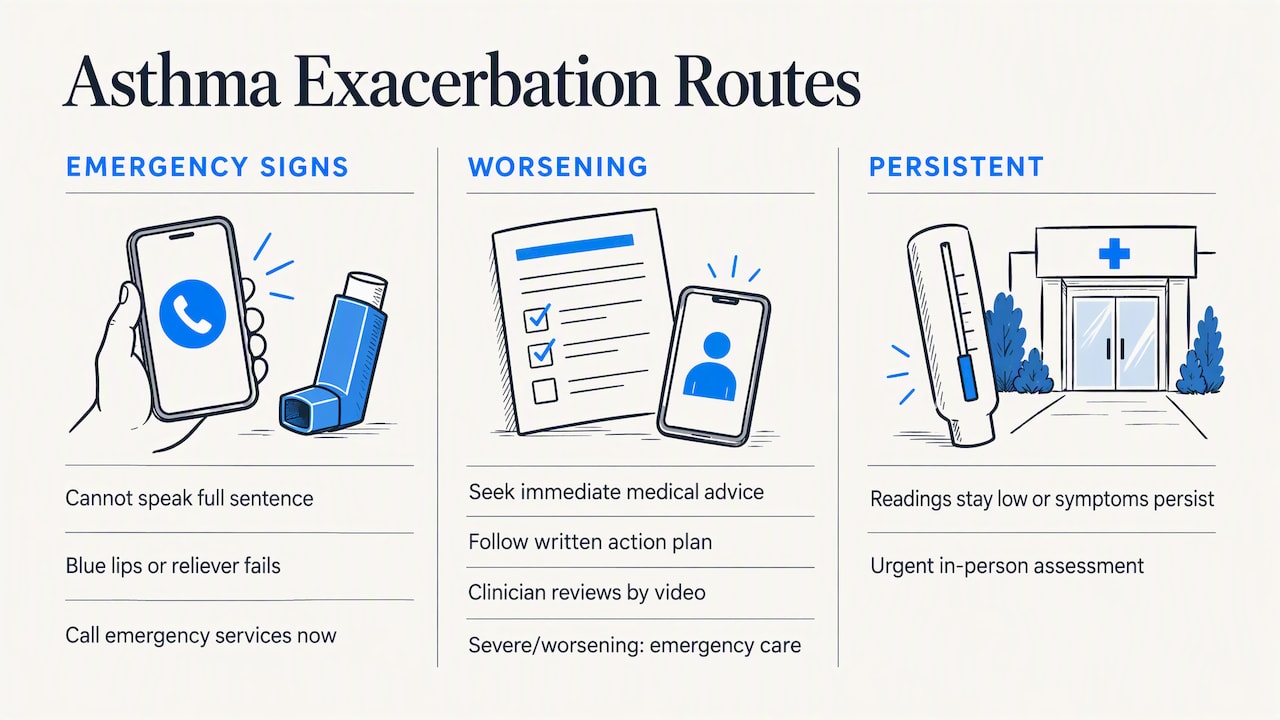
An exacerbation is a worsening of symptoms, and the first rule is that severity decides the route. If you cannot speak a full sentence, your lips look blue, your reliever does not help, or breathing is getting harder, call emergency services immediately. Do not wait for a video appointment.
For worsening symptoms, seek immediate medical advice and follow your written action plan. If symptoms are severe or getting worse, seek emergency care. The clinician checks symptoms, readings and triggers by video, and may adjust treatment according to the plan. Because remote data can show premonitory signs such as changing inhaler use patterns and peak-flow drops, some flare-ups can be caught earlier.
The clinician will also set a clear review point and state which signs mean an in-person visit. If readings stay low or symptoms do not improve, you will be referred for urgent assessment.
Insurance coverage and reimbursement for asthma teleconsultations
Coverage in Portugal depends on whether the consultation takes place within the public health service or with a private provider, and the rules can change. We cannot point you to a primary government source on reimbursement for asthma teleconsultations specifically, so check the current position directly.
In practice, ask three questions before you book. First, does your private health insurance policy cover remote consultations, and does it require a particular network? Second, does a consultation with a private platform count toward any plan you hold? Third, are prescriptions issued after a teleconsultation reimbursed in the usual way at the pharmacy? Your insurer or health subsystem can answer these quickly. Keep the invoice from any consultation, as you may be able to submit it for reimbursement or expense purposes depending on your plan.
Patient education resources and digital self-management tools
Education is half of tele-asthma care. A useful toolkit has a few parts: a validated control questionnaire (ACT for most people, CARAT in Portuguese guidance), a symptom and peak-flow diary, a written action plan stored on your phone, and an inhaler-technique refresher.
Digital tools can bundle these. Apps can log symptoms, remind you to take your preventer, and share a summary with your clinician before a visit. Smart inhalers add automatic dose records. Reviews of digital asthma care stress that tools work best when they feed a real conversation with a clinician, not when they sit unused on a phone.
For children, school-based telehealth education programs help caregivers and teachers understand triggers and plans. Whatever you use, choose tools your clinician can actually read. Ask them which app or report format they prefer, so that your effort translates into better advice.
Legal and regulatory considerations for tele-asthma care
Telemedicine is still medical care, so the usual professional and legal duties apply. Practical points to look for include informed consent for the remote consultation, confirmation of the clinician’s identity and credentials, and protection of your health data under data-protection rules. The Portuguese Pulmonology Society’s guidance puts confirming consent first on its teleconsultation checklist, which reflects how central it is.
Because rules differ by setting and can change, we do not state what is legally permitted in specific cases here. Look to the Portuguese health authorities and professional bodies for current requirements, and ask any provider to explain how they handle consent, record keeping and privacy. A trustworthy service answers these questions plainly and lets you verify who you are speaking with.
Integrating telemedicine with in-person services and specialist referrals
The strongest asthma care is hybrid. Teleconsultations handle routine reviews, medicine adjustments and technique checks, while in-person visits cover diagnosis, spirometry and complex cases. The aim is a smooth handoff, with no gaps between the two.
In practice, that means sharing records so each clinician sees the same history, device data and action plan. When a teleconsultation uncovers uncertainty, such as readings that do not match symptoms, the clinician should arrange the in-person test or a specialist referral and tell you who will follow up. E-consults can shorten that path by letting a primary care clinician get specialist input without a full appointment.
As a patient, you can help by keeping your own summary: last visit date, current medicines, latest readings and any referrals pending. Ask at the end of each teleconsultation, “What would make you want to see me in person?” The answer becomes part of your plan.
My view: telemedicine belongs in routine, hybrid asthma care
I think the useful question is no longer “telemedicine or the clinic?” but “which visit needs which?” Asthma is a long-term condition, and its success rests on continuity: someone who knows your history, notices when your control drifts, and keeps your action plan current. Telemedicine strengthens that continuity, particularly when it is paired with objective data. Seeing real adherence patterns turns a vague conversation into a specific one, and that is where much of the benefit seems to come from.
The evidence supports this measured stance. Intermediate outcomes such as control and adherence improve, while the proof on hospital admissions is still maturing. So I would not oversell it. I would use teleconsultations for stable follow-up, schedule in-person visits for diagnosis and testing, and keep a clear pathway between the two. For many busy families, easy booking and a video follow-up remove the biggest practical obstacle, which is simply getting to an appointment.
What I would most want any patient to take away is this: tools matter less than the plan around them. A cheap peak-flow meter, a written action plan and a clinician who actually reviews your numbers beat an expensive device that nobody reads.
— José
How we can support your asthma follow-up
We offer online consultations by video, so you can book a visit, show your inhaler technique and review your plan without leaving home. Several of our services fit asthma follow-up:
- Online general consultations for adults, from €35 for a Consulta Clínica Geral / Check Up, where you can raise symptoms and ask for an action-plan review
- Pediatric consultations for children, from €55 for Pediatria
- Renovação de Tratamento Médico, our prescription renewal service, at €19, so your regular medicines stay current
- Médico de Família Online, our family doctor plan, from €4.90 per month

Next steps are simple. Book a consultation, gather your medicines and any peak-flow, oximeter or app readings, and ask the clinician to review your asthma action plan and watch your inhaler technique on camera. Please confirm the clinician’s credentials and availability when you book. You can start on our main booking page, where you can see the services and choose a time that suits you.
This article is general information, not a substitute for advice from a qualified doctor. Consult a qualified healthcare professional about your own circumstances before acting on anything here.
FAQ
Can I get asthma medication via telehealth?
Yes, a clinician can renew or adjust asthma treatment after a teleconsultation when they judge it appropriate. They will usually review your symptoms, control and inhaler use first. New or unclear symptoms may need an in-person check.
What is the 4x4x4 rule for asthma?
Sources differ on how this rule is defined, so we do not give a single definition here. Ask your clinician which rule or threshold they use, and have it written into your action plan so you know exactly when to act.
Can stress trigger asthma?
Stress can worsen symptoms in some people, and it is worth noting in your symptom diary alongside other triggers. If you notice a pattern, tell your clinician so your action plan can account for it.
Can you live a healthy life with asthma?
Yes, for most people good control makes an active life possible. Regular follow-up, correct inhaler technique and a written action plan are the foundations, and teleconsultations can help you keep all three up to date.
Sources
- The Effects of Telemedicine on Asthma Control and Patients’ Quality of Life in Adults: A Systematic Review and Meta-analysis
- NÚMERO:
- Using Telemedicine to Care for the Asthma Patient