Telemedicine can work well for many follow-ups, chronic-care monitoring and mental health visits, but it cannot replace a hands-on examination. If you have severe or concerning symptoms, seek immediate emergency care. For a problem that needs a physical exam, arrange an in-person visit. For everything else, a hybrid approach is usually the smartest path, and you can always ask for a physical consultation when it is clinically justified.
TL;DR:
- 83% of clinical effectiveness reviews found telemedicine at least as effective as in person care, though short follow up and study bias limit certainty.
- Telemedicine fits prescription renewals, chronic care follow ups, mental health sessions, routine recovery checks, travel advice, and minor symptom triage without a physical exam.
- Seek emergency care for chest pain, shortness of breath, heavy bleeding, or sudden neurological changes; new or worsening symptoms requiring examination need a clinic visit.
- Remote visits remove travel and can expand specialist access, but appointment availability varies; compare the earliest remote and in person slots before booking.
- Remote care can connect people in underserved areas with distant specialists, but tests and imaging still require a physical site and reliable internet.
Table of Contents
- What does the evidence say about telemedicine vs in-person effectiveness?
- When is telemedicine a good choice?
- When should you see a clinician in person?
- What practical factors should you weigh?
- How do you decide for your specific appointment?
- How do waiting times and appointment availability compare?
- Does telemedicine improve access in remote or underserved areas?
- Why do we recommend a hybrid, patient-centered approach?
- How do you book a teleconsult with us?
- FAQ
- Sources
What does the evidence say about telemedicine vs in-person effectiveness?
The research is more consistent than most readers expect, though it has real limits. Here is what the strongest evidence shows:
- Systematic reviews from 2020 to 2024 find telemedicine comparable to in-person care for many primary care and mental health conditions, on clinical effectiveness, patient satisfaction and quality outcomes.
- A systematic review of teleconsultations in primary care found phone and video visits as effective as face-to-face visits for many outcomes, with shorter consultations and lower travel costs.
- The same review reported variable results across clinical areas and higher discontinuation rates among some teleconsultation patients.
- An umbrella review of telemedicine in OECD countries linked remote care to better disease-specific outcomes in some conditions, such as glycemic control, and fewer hospitalizations.
83% of the clinical effectiveness reviews found telemedicine at least as effective as face-to-face care. That is a strong signal, but it describes the direction of the literature, not a guarantee for your particular problem.
Read this evidence with care. The studies vary widely in design, many follow patients only briefly, and risk of bias is a recurring concern. Acute presentations show more mixed results, and process outcomes such as follow-up visits and lab ordering can differ between the two formats. So “comparable” is a fair summary for many routine situations, and “equivalent for everything” is not.
When is telemedicine a good choice?
Telemedicine fits best when the task is about talking, reviewing and adjusting, not touching. Think of it as a good match for these visit types:
- Prescription renewals. If your condition is stable and your treatment is established, a short video call usually covers it.
- Stable chronic disease follow-up. A clinician can review your readings, adjust a diabetes medication and set the next check.
- Many mental health visits. A cognitive-behavioral therapy session works over video much as it does in a consulting room. Our own comparison of online and in-person psychology consultations goes deeper on this.
- Routine post-operative check-ins. Wound questions, pain control and recovery progress can often be reviewed remotely.
- Travel health advice. A clinician can discuss destination risks and plan vaccines, even though the injection itself happens elsewhere.
- Triage and minor acute advice. A teleconsult can tell you whether a problem can wait, be treated at home or needs an exam.
The process benefits are practical. Visits tend to be shorter, and reviews report lower travel costs. The US health department’s guidance on why people use telehealth adds access to distant specialists and less exposure to contagious illness.
Pro Tip: Write down your three biggest questions before the call. Short visits reward patients who arrive with a focused list.
When should you see a clinician in person?
Some situations should never wait for a video slot. Go to an emergency department or call emergency services for:
- Chest pain or pressure
- Shortness of breath
- Sudden, severe neurological changes such as weakness on one side, confusion or trouble speaking
- Heavy bleeding
These are the kinds of urgent problems that KFF Health News describes as needing in-person care.
Beyond emergencies, a physical exam is the deciding factor. Palpation, auscultation, wound care and many gynecological and ENT examinations simply cannot be done through a screen. New or worsening symptoms that call for hands-on assessment belong in a clinic.
Two other situations lean toward face-to-face care. A first-contact problem with an unclear diagnosis often benefits from an in-person look, and so does complex multi-morbidity, where several conditions interact. MedlinePlus also notes that remote care can mean an incomplete history and coordination gaps at follow-up. If a clinician tells you a physical exam is needed, take that as good clinical judgment, not a failure of the remote visit.
What practical factors should you weigh?
Clinical fit is only part of the decision. A few practical points can make or break a teleconsult.
- Technology: You need a working device, a stable internet connection and a private space. Test your camera and microphone beforehand.
- Tests and prescriptions: A teleconsult can lead to lab or imaging requests, but the sample or scan still happens in person. Ask who arranges it and how results come back to you.
- Cost and time: You save travel and waiting, but a remote visit that ends with “come in for an exam” can add a step. Reimbursement and service availability differ from country to country.
- Privacy: Ask how your data is stored and whether the session is recorded.
Your rights matter too. Portuguese regulator ERS explains that teleconsultations require informed consent and that you may request a physical consultation when it is clinically required.
In the public health system, teleconsultations carry the same guaranteed maximum response times as in-person consultations. Choosing remote care does not cost you a place in line.
How do you decide for your specific appointment?
Use this short checklist right before you book:
- Name the reason for the visit. A new symptom, a follow-up, a mental health session and a certificate each point toward a different format.
- Screen for red flags. If any emergency sign applies, skip the booking and seek in-person or emergency care.
- Ask whether a physical exam or tests are likely. If yes, confirm who arranges them and when.
- Prepare for the call. Gather your medication list, recent readings, good lighting and a private room.
Before you confirm a teleconsult, ask the provider three quick questions:
- What happens if the clinician decides I need an in-person exam?
- How will prescriptions, certificates and test requests reach me?
- Who handles follow-up, and how do I reach them?
Pro Tip: Keep your last prescription box or medication photo handy. It saves minutes at the start of the call and avoids dosage mix-ups.
How do waiting times and appointment availability compare?
Access is where telemedicine often feels different from the first click. An in-person visit means finding a slot, traveling, parking and sitting in a waiting room. A remote consultation removes the travel and usually offers more flexible hours, including evenings, which helps people with tight schedules or caring duties. The US telehealth guidance highlights reduced travel time and expense as core advantages.
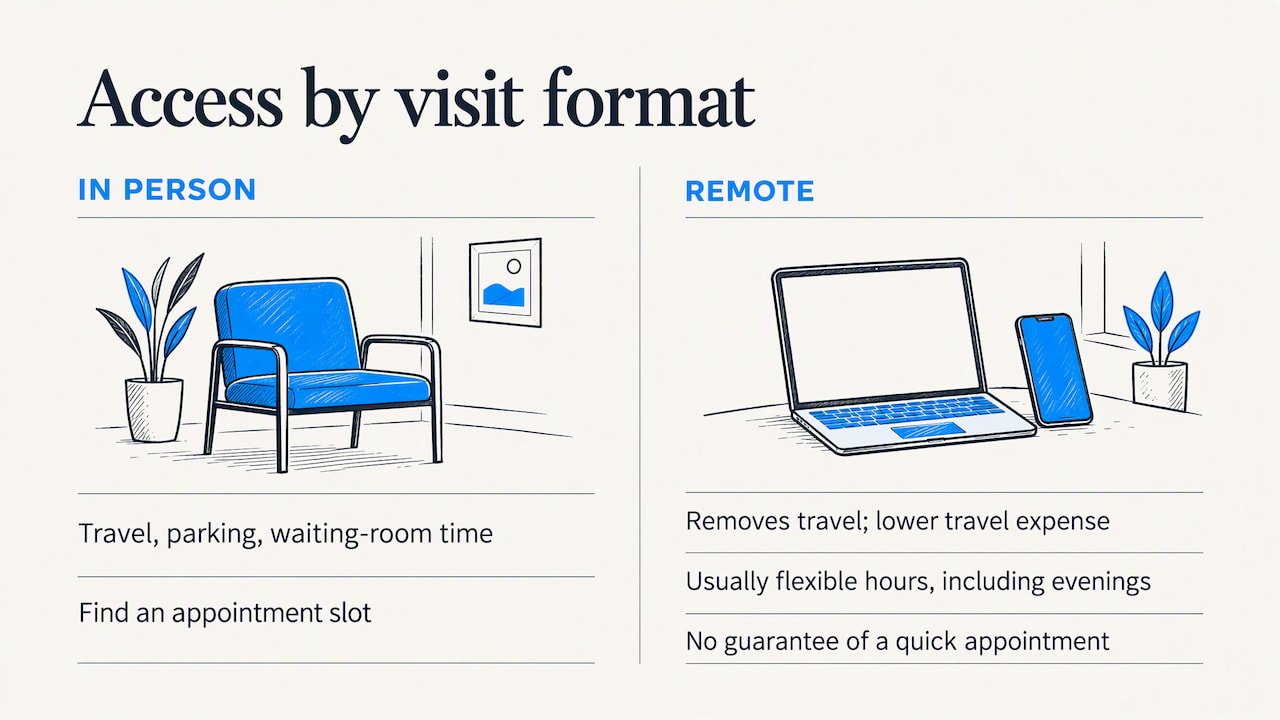
The comparison depends on the system you use. A Portuguese newspaper report described units not meeting waiting-time rules, so a remote label does not automatically mean a quick appointment. Check availability with the provider before choosing a format.
A practical rule: for a routine renewal or a stable follow-up, remote access is usually the faster route to a clinician. For a problem that needs an exam, a quick video call can still help by sorting out urgency, but it will not remove the wait for the physical visit. When you compare options, ask for the earliest available slot in both formats and weigh that against what the visit needs to accomplish.
Does telemedicine improve access in remote or underserved areas?
For people far from a clinic, the difference can be substantial. MedlinePlus lists access for remote communities and after-hours care among the main benefits of telehealth. If the nearest specialist is hours away, a video consultation turns a day of travel into a call, and it opens up expertise that a local service may not have.
The same logic helps people with limited mobility, patients managing long-term conditions who need frequent check-ins, and anyone whose work makes weekday appointments hard. The US telehealth guidance points to access to distant specialists as a key reason to use it.
The benefit has a ceiling, though. A remote visit still depends on a decent connection and a suitable device, and those are not evenly distributed. Tests, imaging and procedures still require a physical site, so an underserved area may gain advice quickly while diagnostics remain far away. This is why WHO guidance on telemedicine frames remote care as a complement to in-person services that improves access and people-centered care, not a replacement.
Why do we recommend a hybrid, patient-centered approach?
Our view follows the evidence: use telemedicine where it matches the clinical task, and keep in-person visits for examination and procedures. That is also what WHO recommends, and it matches Portuguese reporting on the hybrid model of triage, follow-up and chronic management online, with physical visits for exams. Regulators also note that rapport and diagnostic accuracy can be harder online, which is exactly why the choice should be task-based. Dr.Online is an online consultation platform, and we see it as well suited to follow-ups, mental health, prescription renewals and many routine consults.
— José
How do you book a teleconsult with us?
You pick a service, choose a time, join the video consultation and then receive your prescription, certificate or a plan for follow-up. Our main services for telemedicine-friendly needs include family medicine online from €4.90 per month, mental health care through Psiquiatria at €80 and Psicologia Clínica Adultos at €49, Renovação de Tratamento Médico at €19, medical certificates, and urgent adult consultations.

If the clinician decides you need a physical exam, we say so and help you plan the next step. Ready to start? Choose your consultation and book a time with us.
This article is general information, not a substitute for advice from a qualified doctor. Consult a qualified healthcare professional about your own circumstances before acting on anything here.
FAQ
Is telehealth considered direct patient care?
Yes. Telehealth delivers care through video, phone or remote monitoring, and MedlinePlus describes it as a way to provide care remotely. The clinician still assesses you, treats you and takes responsibility for your care.
What is a virtual consultation?
A virtual consultation is a medical appointment held over video or phone instead of in a clinic. You speak with a clinician, share your history and leave with advice, a prescription, a certificate or a referral.
What are examples of digital health?
Common examples include video consultations, phone follow-ups and remote monitoring of readings such as blood sugar. MedlinePlus lists video, phone and remote monitoring as core telehealth tools.
What are the disadvantages of virtual visits?
Virtual visits cannot replace a physical exam, and they can mean an incomplete history and coordination gaps at follow-up. One systematic review also noted higher discontinuation rates among some teleconsultation patients.
Sources
- Effectiveness of telehealth versus in-person care during the …
- The effectiveness of teleconsultations in primary care: systematic review – PMC