Most pink eye (conjunctivitis) can be managed safely at home, and a video consultation is a sensible way to find out whether yours is one of those cases. A doctor can look at your eye on camera, ask about discharge, pain, vision and contact lenses, and tell you whether home care is enough, whether a prescription is appropriate, or whether you need an eye exam in person. Below you will find what to do in the first 48 hours, how to tell the types apart, and what an online consultation can and cannot do.
TL;DR
- Most pink eye is viral and clears up by itself in about one to two weeks. Cold compresses, artificial tears and strict hygiene are the core treatment.
- Antibiotic drops only help bacterial cases, and a doctor decides when they are appropriate. Do not use leftover drops or “whitening” drops.
- Pain, reduced vision, light sensitivity, contact lens wear, a newborn or a weak immune system mean you should be examined quickly, not just managed at home.
- In Portugal you can book a video consultation on our urgent care page: €35 for adults, €50 for pediatric urgent care.
Table of Contents
- What pink eye actually is
- Pink eye treatment at home: what is safe
- Do you need antibiotics?
- Red flags: when a video consultation is not enough
- What a video consultation can do for you
- Children and pink eye
- What it costs in Portugal
- Our perspective
- Book a consultation
- A simple plan for the first three days
- FAQ
- Sources
What pink eye actually is
Conjunctivitis is inflammation of the conjunctiva, the thin membrane covering the white of the eye and the inside of the eyelids. SNS 24 describes it as a benign condition that shows up as red eyes, a feeling of grit or sand, itching, burning, clear or yellowish discharge, and eyelids stuck together, especially on waking.
Three causes account for nearly every case:
| Type | Typical signs | Contagious? | Usual course |
|---|---|---|---|
| Viral | Watery discharge, red eye, often after a cold or sore throat | Yes | Resolves without medication, often in 7 to 14 days |
| Bacterial | Thicker, sticky yellow or green discharge, lids glued shut | Yes | May clear alone; a doctor may prescribe drops |
| Allergic | Intense itching, watery eyes, both eyes, sneezing | No | Improves when the trigger is removed |
The CDC says most viral pink eye is mild and usually clears up in 7 to 14 days without treatment and without long-term consequences. Telling the types apart by looking is not always easy, even for professionals, which is one reason a short consultation can be useful.
Pink eye treatment at home: what is safe
The home measures are the same whether you treat the eye yourself or after a video consultation. They are also the part of treatment that matters most.
Relieve the symptoms
- Artificial tears. They soothe dryness and irritation. Both Mayo Clinic and the National Eye Institute list over-the-counter drops and cold compresses for mild cases.
- Compresses. A clean, damp cloth, cold or warm depending on what feels better. Use a fresh cloth each time, and a separate one for each eye if both are affected.
- Saline. SNS 24 suggests saline, preferably in single-dose vials for each eye, to avoid passing the problem from one eye to the other.
- Clean the lids. Wipe away crusts from the lash line with a clean, wet cloth, from the inner corner outward, once per wipe.
Stop it spreading
Viral and bacterial pink eye are contagious. Wash your hands often, do not touch or rub your eyes, do not share towels or pillowcases, and change your pillowcase daily while symptoms last. Children with a clearly infectious eye should stay away from nursery or school until a doctor says otherwise, and that is a case where a certificate can be needed (more on that below).
What not to do
- Do not use redness-removing (“whitening”) drops. They mask the redness without treating the cause and can irritate the eye further. The American Academy of Ophthalmology advises sticking to saline, artificial tears and clean cold compresses while you wait for evaluation.
- Do not put breast milk, tea, honey or any home preparation in the eye. They are not sterile.
- Do not reuse old antibiotic drops. They may be expired, contaminated or wrong for your infection.
- Do not wear contact lenses. The CDC advises stopping lens wear until your eye doctor says you can restart, or until symptoms are gone if you did not see one. Switch to glasses, and ask your doctor about replacing lenses and the case.
Do you need antibiotics?
Usually not. The clinical consensus reflected by SNS 24 and the AAO is that most conjunctivitis is viral and self-limiting, so antibiotics do nothing for it. Patience and good hygiene do most of the work. Antibiotic drops are kept for specific bacterial cases, and for situations where a doctor wants to rule out something else.
The allergic form calls for a different approach. The most effective step is to remove the trigger: pollen, smoke, chlorine, pet dander. Medicines are a helper, not a replacement for that. If you notice that your eyes itch every spring or after swimming, say so in your consultation, because that pattern points the doctor in the right direction.
This is why “online treatment” for pink eye is less about getting a pill and more about getting the right call: home care, a prescription, or an in-person exam.
Red flags: when a video consultation is not enough
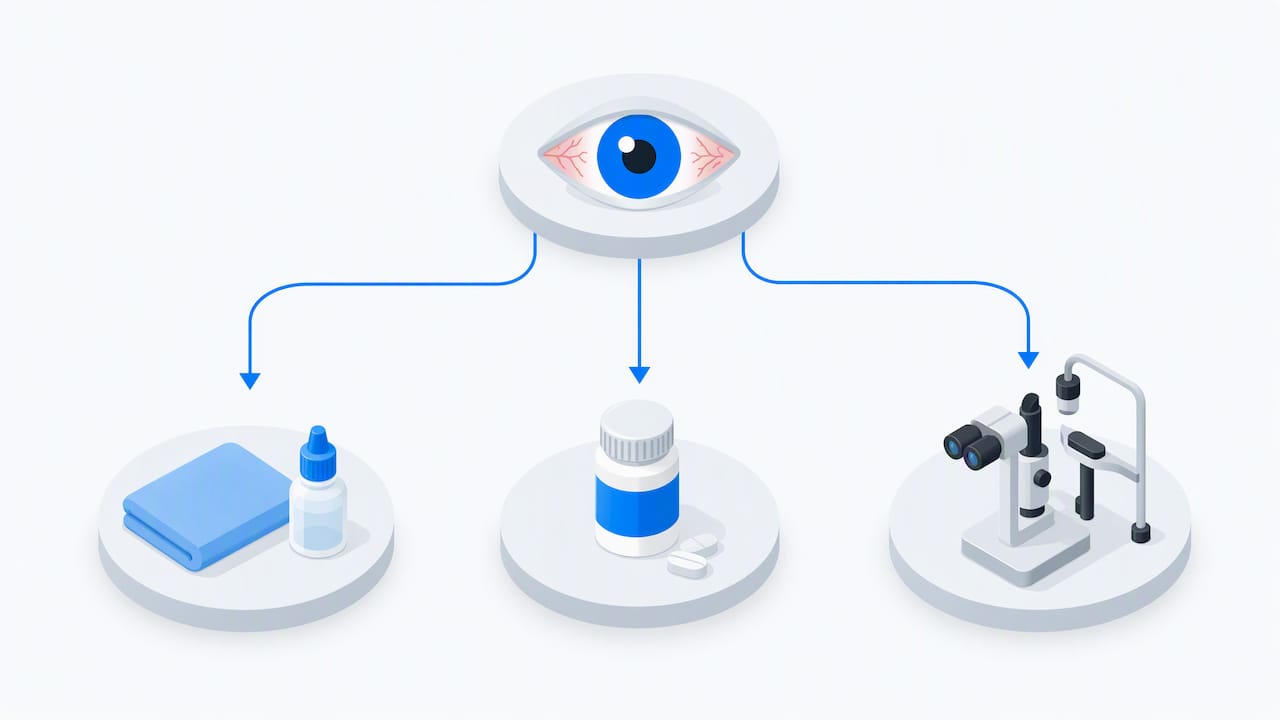
Some signs mean the eye needs a hands-on exam with proper equipment, today if possible. Go to an urgent care service or hospital emergency department in Portugal, or call SNS 24 on 808 24 24 24, if you have:
- Moderate to severe eye pain, not just irritation
- Blurred or reduced vision that does not clear when you blink
- Strong sensitivity to light
- A very red eye after a chemical splash, a foreign body or an injury
- Pink eye while wearing contact lenses, especially with pain
- A weakened immune system
- A newborn with any sign of pink eye. The CDC says newborns with symptoms should see a doctor right away.
The CDC also lists pus-like discharge and certain bacterial causes among reasons to seek care. If your symptoms get worse after a few days instead of better, book a consultation or be seen in person.
These limits are real. A video call cannot replace the instruments an ophthalmologist uses to examine the surface and inside of the eye. A good online doctor will say so when it applies, and send you where you need to go.
What a video consultation can do for you
For the typical case (a red, itchy or sticky eye, no pain, normal vision), a video consultation is quick and practical:
- The doctor asks when it started, which eye, what the discharge looks like, whether you wear lenses, and whether anyone around you has similar symptoms.
- You show the eye on camera in good light, including the lids and the white of the eye.
- The doctor tells you which type it most likely is and what to do: home care, drops if appropriate, or an in-person exam.
- You get advice on hygiene, how long you may be contagious, and when to come back.
If a medicine is clinically appropriate, the doctor decides this case by case. We do not promise a prescription, because for most viral cases the right answer is not one.
Good light, good answers
Before the call, wash your hands, sit by a window or under a bright lamp, take out your lenses, and have a list of any eye drops or medicines you already use. If it is your child, keep them calm and well lit, and be ready to describe how they slept and whether they have a fever or ear pain.
Children and pink eye
Pink eye is common in toddlers and school-age children, and it spreads easily in nurseries. The measures are the same as for adults: saline, clean cold compresses, hand washing, separate towels. Anything that looks more serious than a red, sticky eye needs quick attention: fever, a swollen eyelid, pain, a child who will not open the eye or cannot tolerate light, or any symptoms in a newborn.
For children, our pediatric urgent care consultation costs €50. If the school or nursery asks for proof that your child can return, we also offer an online medical certificate for nursery and school at €35.
What it costs in Portugal
Prices published on our site, as read on 15 October 2026:
| Service | Price |
|---|---|
| Urgent medical consultation (adults) | €35 |
| General practice consultation / check-up (adults) | €35 |
| Pediatric urgent care | €50 |
| Online medical certificate for nursery and school | €35 |
| Online sick leave (temporary incapacity certificate) | €39 |
| Médico de Família Online (plan) | from €4.90 per month |
The sick leave certificate is relevant if your work involves close contact with others or you cannot use a screen safely while your eye recovers. Whether a certificate is issued is always the doctor’s clinical decision.
Our perspective
Pink eye is a good example of what telemedicine is for. It is common, usually benign, uncomfortable, and easy to mishandle: people either rush to get antibiotics they do not need, or put up with a painful eye for days because they cannot get an appointment. Neither helps.
We built Dr.Online so patients in Portugal can reach a doctor without queues, from home, at times that fit a working day or a family routine. That matters most for parents with a sick child, people with limited mobility, and those who live far from a clinic. For pink eye, the value of that access is a fast answer to three questions: is this likely viral, bacterial or allergic, can I manage it at home, and do I need to be seen in person?
We also think good telemedicine knows its limits. Eye pain, vision changes and contact lens problems are not for a camera. Telling you that clearly, and quickly, is part of preventive care and part of earning your trust.
— José
Book a consultation
If your eye has been red and sticky for a day or two and you would like a doctor to take a look, you can book a video consultation on our urgent care and general practice page. If you would like ongoing access, the Médico de Família Online plan starts from €4.90 per month. Not sure what you are dealing with? Our online symptom checker is a good first step, and you can see all our services on the English home page.
A simple plan for the first three days
Day 1. Start saline rinses and artificial tears, use cold compresses, stop lens wear, wash hands often. Notice whether one or both eyes are affected, and whether the discharge is watery or thick.
Day 2 to 3. Expect viral cases to look about the same or slightly better. If vision changes, pain appears, or the eyelid swells, get examined. If thick discharge keeps gluing the lids shut, book a consultation.
Day 4 onward. Most mild cases improve within about a week. If your eye is not clearly better by then, or you have no improvement after a doctor’s treatment, ask to be reviewed. Keep your own towel and pillowcase until symptoms are gone.
FAQ
Can I get pink eye treated entirely online?
Often the assessment and advice can be done online, especially for mild cases without pain or vision changes. Many cases need only home care. If the doctor sees signs that need an examination with equipment, you will be referred to an in-person service.
How long is pink eye contagious?
It depends on the cause. Viral and bacterial forms are contagious while the eye is red and producing discharge, and allergic pink eye is not contagious at all. Ask your doctor about your specific case, and keep up strict hand hygiene and separate towels in the meantime.
Which eye drops should I buy at the pharmacy?
Plain artificial tears and single-dose saline are the safe choices for mild symptoms, as listed by SNS 24 and Mayo Clinic. Avoid redness-removing drops and any antibiotic drops that were not prescribed for this episode. If you are unsure, ask the pharmacist or book a consultation.
Can my toddler be treated for conjunctivitis online?
Yes, in most uncomplicated cases a pediatric consultation can assess the eye, advise on care and say whether treatment is needed. Babies under one month with any eye symptoms should be seen in person right away, and so should any child with pain, fever, a swollen lid or light sensitivity.
Sources
- SNS 24: Conjuntivite
- CDC: How to Treat Pink Eye
- American Academy of Ophthalmology: Pink Eye, Quick Home Remedies
- Mayo Clinic: Pink eye, diagnosis and treatment
- National Eye Institute: Pink Eye