Yes, you can get a sinus infection assessed and treated through a video consultation in Portugal. A doctor can listen to your history, tell a probably viral cold from something that needs treatment, explain self-care, and decide whether an antibiotic or an in-person exam is needed. What you should not expect is an automatic antibiotic prescription. Most sinus infections improve on their own, and a good doctor will tell you so.
This guide explains how an online visit works, when antibiotics are and are not appropriate, which symptoms mean you should not wait for a video call, and how to prepare so the 15 or 20 minutes you have are useful.
TL;DR
- A video consultation is well suited to mild or moderate sinus symptoms with no warning signs. The doctor assesses your history and decides on self-care, watchful waiting, an antibiotic or an in-person visit.
- According to the CDC, many sinus infections do not need antibiotics. Yellow or green mucus alone does not prove a bacterial infection.
- Severe facial pain, swelling around the eye, vision changes, a stiff neck, confusion or trouble breathing need urgent in-person care, not a video visit.
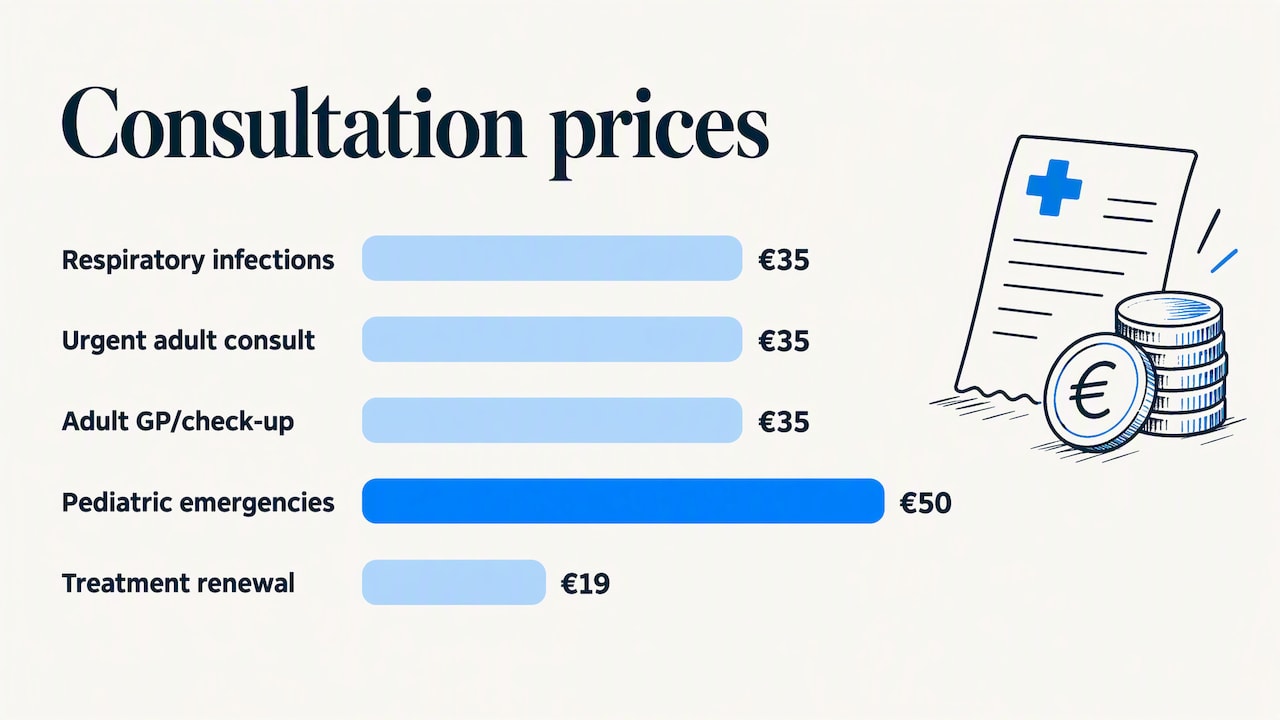
- At Dr.Online, an adult urgent consultation costs €35 and the Flu, Covid-19 and Respiratory Infections consultation also costs €35.
- Prepare your timeline, temperature readings, medications and allergies before you connect.
Table of Contents
- What a sinus infection actually is
- Can a video consultation treat a sinus infection?
- When antibiotics help, and when they do not
- Red flags: when not to wait for an online visit
- Natural relief you can start today
- Sinus symptoms during pregnancy
- How to prepare for your online consultation
- Our perspective: why we sometimes say “no antibiotic”
- Costs and options at Dr.Online
- What happens after the consultation
- Sinusitis in children
- Online visit or in-person visit?
- Preventing the next one
- FAQ
- Sources
What a sinus infection actually is
Sinusitis is inflammation of the sinuses, the air-filled spaces around your nose, cheeks and forehead. It usually starts after a cold. The nose blocks up, the face feels heavy, and the symptoms drag on longer than you expected.
The key point is that most cases are caused by viruses, not bacteria. The CDC explains that you do not need antibiotics for many sinus infections and that your healthcare provider can decide whether you need one. That is why the question “can I get antibiotics online?” is really the wrong first question. The better one is: “Is my infection the kind that antibiotics can help?”
Typical symptoms include:
- a blocked or runny nose
- pressure or pain around the cheeks, eyes or forehead
- reduced sense of smell
- cough, especially at night
- tiredness and sometimes a low fever
These overlap heavily with a common cold, with flu, with Covid-19 and with allergic rhinitis. Telling them apart is a clinical judgment based on how long the symptoms have lasted, how severe they are and how they are changing, not on a single symptom.
Can a video consultation treat a sinus infection?
For most people with mild or moderate symptoms and no warning signs, yes. A sinus infection is largely diagnosed from your story, and a video visit is built for that conversation.
During the consultation, the doctor will typically:
- Ask when it started and how it has progressed.
- Ask about fever, facial pain, the type of nasal discharge and any improvement followed by worsening.
- Check your allergies, chronic conditions, current medications, pregnancy status and any recent antibiotics.
- Look at your general appearance on camera, your breathing and the areas of facial tenderness you point to.
- Explain what is most likely going on and what to do next.
The CDC notes that the diagnosis should not rest on the color of your mucus alone. Duration, severity, the course of the illness and your overall clinical context matter more. A doctor on video can weigh all of those.
What a video visit cannot do
It cannot examine your nose with an endoscope, take a scan or run blood tests. If your doctor believes you need that, the right outcome of the visit is a referral or advice to be seen in person. That is not a failed consultation. It is the safety function of a good one.
When antibiotics help, and when they do not
Searches such as “sinus infection antibiotics online” are common, so let us be direct about it.
The CDC says most sinus infections get better without antibiotics. A professional may recommend watchful waiting for two to three days, or a delayed prescription, before starting one. The logic is simple: if your immune system is about to clear a viral illness, an antibiotic gives you the side effects without the benefit.
Unnecessary antibiotics can cause adverse reactions such as stomach upset and diarrhea. They also contribute to antimicrobial resistance, which is a public health problem, not just a personal one. Saying no to a prescription is therefore often a safety decision, not a refusal to help.
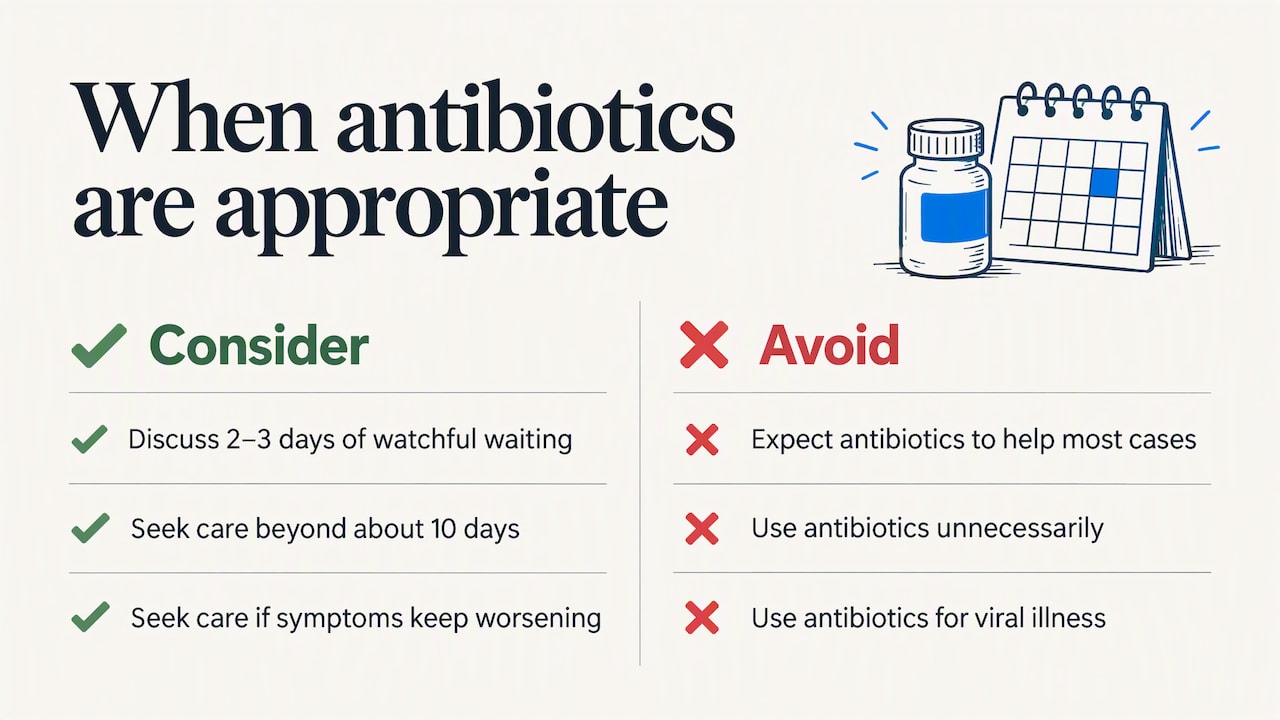
An antibiotic may be considered when the picture suggests a bacterial infection, for instance when symptoms are severe, last longer than expected, or get worse after an initial improvement. The CDC advises seeing a provider if symptoms persist beyond about 10 days or keep getting worse. Whether it is appropriate in your case is the doctor’s call, based on your history and any risk factors.
Rules that protect you
- Never take leftover antibiotics from an earlier illness.
- Never share medication with a partner or child.
- Do not ask for a specific drug. Describe your symptoms and let the doctor choose.
- If you are given an antibiotic, finish the course as directed unless the doctor tells you otherwise or you have a reaction.
Red flags: when not to wait for an online visit
A video consultation is the wrong tool when something looks serious. The CDC advises seeking medical evaluation promptly if you have any of the following. Go to an emergency department or call 112 if they are severe or sudden:
- a high fever
- strong facial pain
- swelling of the face or around the eyes
- changes in vision
- confusion
- a stiff neck
- difficulty breathing
- a weakened immune system
- symptoms that return and worsen after you seemed to be getting better
These can signal a complication that needs a physical examination or hospital care. If you are unsure, an online doctor can help you decide, but if the symptoms are severe, go first and call later.
Small children, pregnant women, older adults and people with weakened immunity should contact a professional sooner than others. For a child, we offer separate pediatric care, described below.
Natural relief you can start today
Many readers also ask how to get rid of a sinus infection naturally. The CDC lists simple measures that ease symptoms while your body does the work:
- rest and plenty of fluids
- a warm compress over the nose and forehead
- saline nasal spray
- steam, for example from a hot shower
- over-the-counter medication used as directed
These measures relieve symptoms. They do not replace an assessment if the illness persists, worsens or shows warning signs.
A note on nasal rinsing
If you rinse your nose, use a proper saline solution and water that is distilled, sterile, or boiled and then cooled. Do not put tap water straight into your nose. Stop and get advice if rinsing causes severe pain, bleeding or makes things worse.
Decongestants and painkillers
Choose them carefully. Age, pregnancy, high blood pressure, heart disease, glaucoma, interactions and other medicines all matter. Ask your doctor or pharmacist before you buy anything, especially if you take regular medication.
Sinus symptoms during pregnancy
Congestion in pregnancy is often pregnancy rhinitis rather than bacterial sinusitis. That means the first conversation is usually about non-drug measures. Any antibiotic, decongestant or anti-inflammatory should be checked by a professional who knows your gestational age and what else you take. Do not treat yourself from the medicine cabinet. An online visit is a reasonable first step for mild symptoms, as long as none of the red flags above apply.
How to prepare for your online consultation
The more precise your history, the better the decision. Before you connect, write down:
| What to prepare | Why it matters |
|---|---|
| How many days you have had symptoms | Duration is one of the main clues to a bacterial cause |
| Temperature readings, with dates | Fever pattern helps separate viral from bacterial illness |
| Where the pain is and how strong it is | Pain on one side or severe pain raises concern |
| Whether you improved and then got worse | A second worsening is a classic reason to consider treatment |
| Color and type of discharge | Useful context, though not proof on its own |
| Allergies, pregnancy, chronic conditions | Determine which medications are safe |
| Current medication and past antibiotics | Avoids interactions and repeated ineffective treatment |
Also check that your camera and microphone work, sit somewhere quiet and have a thermometer within reach. If you need a prescription, keep your health details and ID handy.
If you are not sure your symptoms need a doctor at all, the online symptom checker on our site is a quick first step. It does not replace a consultation, but it can help you describe what is happening.
Our perspective: why we sometimes say “no antibiotic”
We built our platform to make medical care easy to reach: no waiting room, no travel, and a doctor you can speak to from home, which matters for people with limited mobility, busy schedules or who live far from a clinic. Convenience, though, is never a reason to hand out treatment that does not help.
Sinus infections are a good example. A patient who connects with a blocked nose after four days of cold symptoms is very likely dealing with a virus. The most useful things we can offer are a clear explanation, a self-care plan, advice on which warning signs to watch for, and a defined point at which to come back. If the story points elsewhere, we say so and we recommend an in-person visit.
People sometimes feel let down when a consultation ends without a prescription. We understand that. But a consultation is not a transaction for a box of pills. It is an assessment, and sometimes the right result is reassurance, a plan and a follow-up. We think that is what preventive, trustworthy telemedicine looks like.
— José
Costs and options at Dr.Online
Prices below are those published on our site. Each is a one-off fee per consultation unless stated.
| Consultation | Price |
|---|---|
| Flu, Covid-19 and Respiratory Infections | €35 |
| Urgent Medical Consultation (Adults) | €35 |
| General Practice / Check-up (Adults) | €35 |
| Pediatric Emergencies | €50 |
| Treatment Renewal | €19 |
| Family Doctor Online (monthly plan) | from €4.90 per month |
For a stuffy nose and facial pressure in an adult, the Flu, Covid-19 and Respiratory Infections consultation is the natural starting point. If your symptoms are more intense or have come on quickly, the urgent consultation page explains how adult and pediatric urgent visits work. If you already have a treatment prescribed for recurring sinus problems, a treatment renewal costs €19.
If you are also dealing with a long illness, you may need a sick-leave certificate. Our medical certificates page lists what we issue, including online sick leave at €39 and school or nursery certificates at €35. Whether a certificate can be issued depends on the doctor’s clinical assessment.
What happens after the consultation
The outcome usually falls into one of four categories.
- Self-care and watchful waiting. You get a plan for rest, fluids, saline and symptom relief, along with clear criteria for when to get back in touch. This is the most common outcome for viral illness.
- Delayed or immediate treatment. If the picture suggests a bacterial cause, the doctor may decide on an antibiotic or on waiting two to three days first, as the CDC describes.
- Further evaluation. If something does not add up, you may be referred for an examination, tests or an ENT specialist.
- Urgent care. If the doctor sees a warning sign, you will be told to go to the emergency department.
In every case, follow the instructions you are given and watch your progress. If you get worse, or a new symptom appears, do not wait for the planned review date.
Sinusitis in children
Children catch colds all the time, and persistent nasal discharge in a child is more often a long cold than a bacterial sinus infection. Still, children need a lower threshold for medical advice, particularly if they are very young, have a high fever, swelling around the eye or seem unusually drowsy. If your child has such symptoms, do not wait for an appointment. Our pediatric emergency consultation costs €50 and a pediatrics specialty consultation costs €55, both available from the specialties page and the urgent care page. Never give a child adult medicines or leftover antibiotics.
Online visit or in-person visit?
| Situation | Better option |
|---|---|
| Several days of blocked nose and mild pressure | Online consultation |
| Symptoms beyond 10 days without improvement | Online consultation, with possible referral |
| Worsening after a period of improvement | Online consultation soon, or in-person if severe |
| Severe pain, facial swelling, vision changes | In-person urgent care now |
| Stiff neck, confusion, trouble breathing | Emergency services (112) |
| Repeated sinus infections over months | Online first assessment, then ENT specialist |
The choice is not about technology. It is about what the doctor needs to see to decide safely.
Preventing the next one
You cannot avoid every cold, but a few habits reduce the odds of a cold turning into a long sinus problem:
- Wash your hands often during cold season.
- Keep indoor air from becoming too dry, and ventilate rooms.
- Manage allergies with a professional, since long-term nasal inflammation makes sinuses vulnerable.
- Avoid smoke.
- Stay hydrated and rest when you are ill.
If you have sinus problems several times a year, a conversation with a doctor about underlying causes is more useful than repeated short-term fixes. For ongoing follow-up, our monthly Family Doctor Online plan starts at €4.90 per month, and you can see what it includes on our home page.
FAQ
Can I get antibiotics for a sinus infection online?
Only if the doctor judges that they are appropriate. Many sinus infections are viral and improve without antibiotics, so the doctor may recommend self-care and watchful waiting first. If your history points to a bacterial infection, an antibiotic can be prescribed after the assessment.
How long should I wait before seeing a doctor for sinus symptoms?
The CDC suggests seeing a provider if symptoms last more than about 10 days or get worse. Seek care sooner for severe pain, high fever, facial or eye swelling, vision changes, a stiff neck or trouble breathing. Those signs call for in-person care.
Does green or yellow mucus mean I need an antibiotic?
No. Colored mucus on its own does not prove a bacterial infection, and many viral illnesses produce it. The doctor looks at how long you have been ill, how severe it is and how it has changed.
What can I do for sinus pressure at home?
Rest, drink fluids, apply a warm compress to your nose and forehead, use saline spray and breathe steam from a hot shower. Use only sterile, distilled or boiled and cooled water for nasal rinsing. Check with a doctor or pharmacist before taking decongestants or painkillers if you are pregnant or have a chronic condition.
Is an online consultation safe if I am pregnant?
It can be a sensible first step for mild symptoms, because congestion in pregnancy is often pregnancy rhinitis rather than infection. Any medicine, including antibiotics, decongestants and anti-inflammatories, should be validated by a professional who knows how far along you are. If you have severe symptoms, go to a hospital.